Skip to Content
Automower® support
How to create a secondary area in Automower® boundary wire installations
If a part of your lawn is not connected to the rest of the lawn by a passage that Automower® can travel through, you can designate this location as a secondary area. This is useful, for example, if your front yard and backyard are separated or if you wish to share Automower® robotic lawn mower with your nearest neighbour. By using a secondary area, you only need one installation with a single charging station and one boundary wire. The boundary wire is laid out in a loop around the entire work area.
For EPOS® wire free installations, see:
Understanding secondary areas
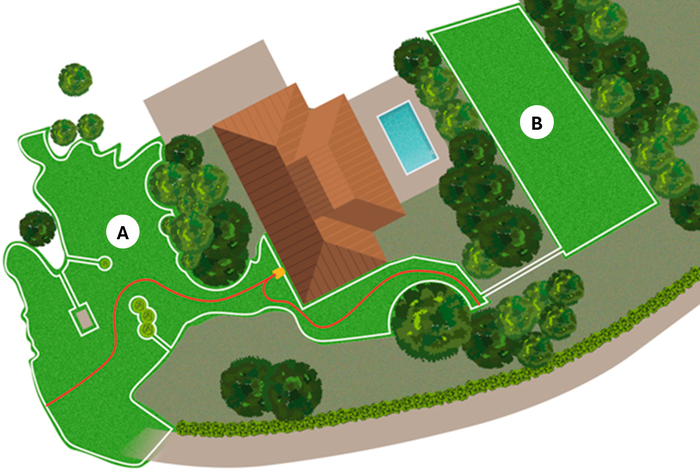
The work area with the charging station is referred to as the main area (A).
The secondary area (B) is not connected to the main area by a passage.
The boundary wire must be laid out in a loop around the entire work area (A+B). Note that the recommended maximum length of the boundary wire is 800 metres/2600 feet (for Aspire™ R4: 300 metres/980 feet).
Operating in a secondary area
To operate Automower® in the secondary area, manually move the mower to the secondary area and select Start > Secondary area in the mower display or in the Automower® Connect app.
In secondary area mode, Automower® operates for a selected period of time or until the battery is empty. It will not search for the charging station. After mowing in a secondary area, you must manually place Automower® in the charging station to recharge.
Remember to set Automower® to Main area mode before returning it to the charging station, otherwise it will not resume operation according to the schedule.
AIM technology and secondary areas
This section applies only to Automower® models that support AIM Technology:
The virtual map (My Lawn) created by AIM Technology does not display secondary areas and cannot be used to establish work areas or stay-out zones in a secondary area. Despite the secondary area not being included in the virtual map, you can mow the area as usual; Automower® will follow the boundary wire. You will still need to manually move Automower® to the secondary area.
During the mapping of the lawn in your primary work area, you can move Automower® to the secondary area as necessary without interfering with the mapping process.